

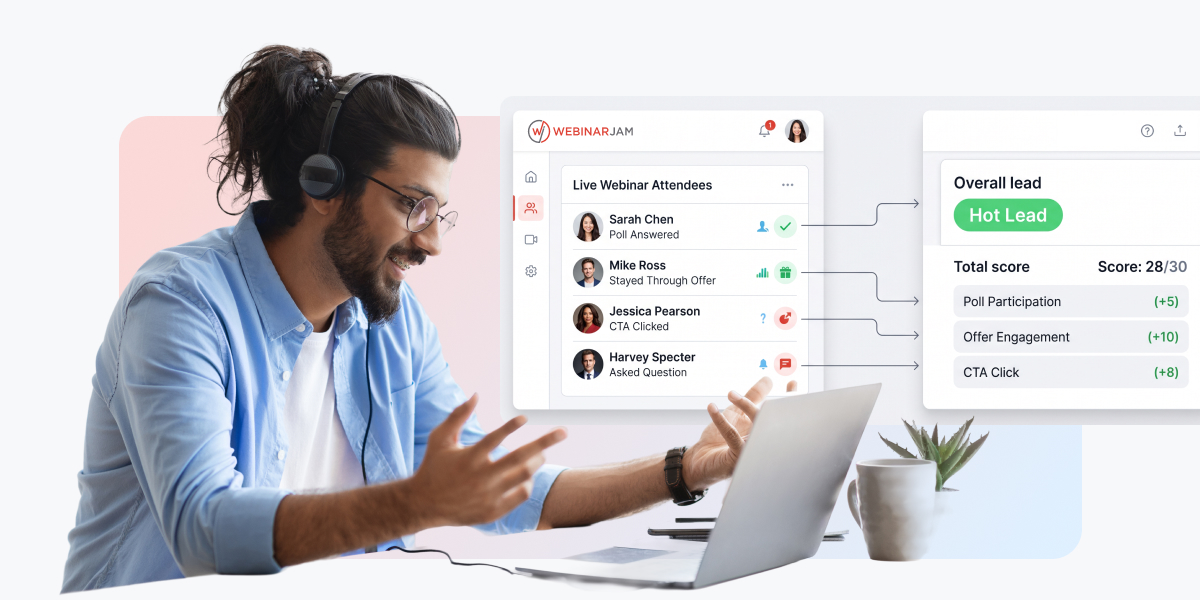
Four hundred people registered for your webinar. It feels like a pipeline.
It isn’t. Close to half of them won’t show up, a chunk of the rest only wanted the replay, and somewhere in that list are the dozen people who actually want to buy. The registration form can’t tell you who they are. Their behavior can.
400 registrationsThe dozen who actually want to buy
That’s the core of webinar lead generation done properly: a registration is a signal to watch, not a signal to buy. The real lead data arrives during and after the session, in who showed up, how long they stayed, what they clicked and what they asked.
Below is how to read those signals, a lead scoring model you can copy and adjust, what to do with each score, and how to get the data into your CRM without doing it all by hand.
Table of Contents
Why isn’t a registration a lead? Because it tells you someone wanted to watch, not that they want to buy.
56%
of registrants went on to attend
In ON24’s 2024 Digital Engagement Benchmarks report, 56% of registrants went on to attend. That’s across enterprise B2B audiences, and it still means close to half the people who filled in a registration form never showed up.
Even among the people who did attend, intent varies wildly. Some stayed for the whole session and clicked the offer. Some left at minute eight. Treat them all as the same lead and your follow-up is wrong for most of them.
High-quality leads aren’t defined by who registered. They’re defined by what people did afterward. That’s the shift that makes webinars worth running for lead gen: from counting registrants to scoring behavior.
Which behaviors actually signal intent?
In webinar lead generation, not all engagement means the same thing. It helps to separate intent signals, which show interest in the topic, from buying signals, which show interest in buying.
Intent signals
Tell you someone cares about the problem.
- Attending live
- Staying past the halfway mark
- Answering polls
- Grabbing the downloadable resources you share during the session
Someone showing intent signals needs more value.
The distinction matters because each needs a different follow-up.
Interactive elements do double duty here. Polls and questions keep attention up during the session, and every answer is a data point you can score. A webinar with no interaction produces almost no signal beyond attendance.
A webinar lead scoring model you can copy
Here’s a starting model for webinar lead generation, built on behavior rather than registration. Add up each person’s points after the session.
Then sort by total:
- Under 10: cold. Registered, maybe attended briefly, showed little else.
- 10 to 24: warm. Engaged, but not yet weighing a purchase.
- 25 and up: hot. They heard the pitch and acted on it.
Anyone who buys leaves the scoring entirely.
Two honest caveats. These numbers are a starting point, not a benchmark. The right weights for your business are whatever predicts who actually buys, so compare them against your conversion rates after a few webinars and adjust. And the model only works if your webinar collects the signals in the first place. No polls and no offer means nothing to score beyond attendance.
What to do with each score
Scoring is only useful if each band triggers something different. That’s the step where webinar lead generation turns into revenue. Whether “sales” means an SDR team or you picking up the phone yourself, the logic holds.
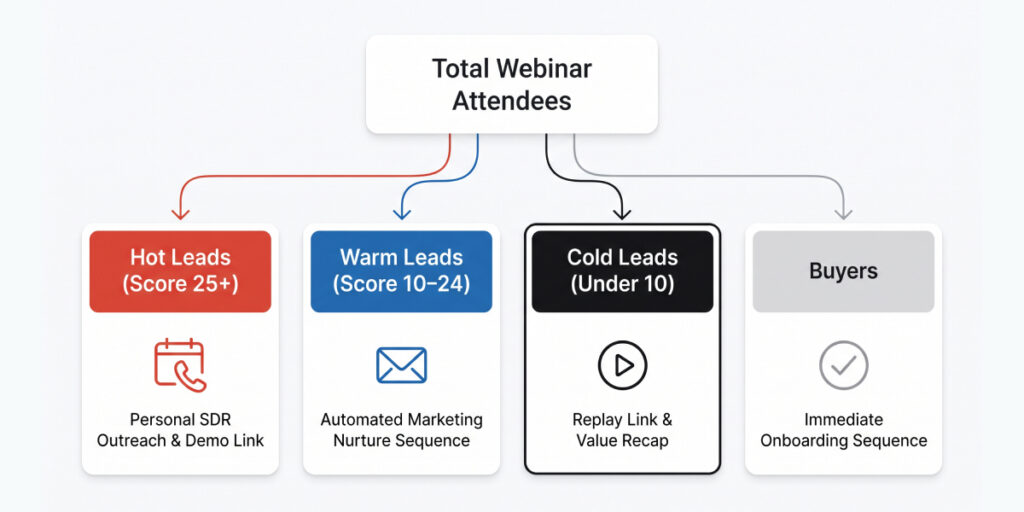
25 and up: hot
Hot leads get a person, fast.
A call, a personal email, a calendar link. Intent is freshest in the first day or two after the session, and it fades quickly.
10 to 24: warm
Warm leads go into nurture sequences.
They’re interested but not ready, so marketing automation keeps the relationship going with more value: a case study, a related resource, an invite to the next session. Move them down the sales funnel rather than pushing for the sale.
Under 10: cold
Cold leads get the replay and one good reason to watch it.
Plenty were busy, not uninterested. Don’t write them off, but don’t spend a salesperson’s hour on them either.
Bought
Buyers leave the sales flow immediately and move into onboarding.
Nothing sours a new customer faster than being pitched what they already bought.
For the actual emails each group should get, see our guide to webinar follow-up emails.
How do you get lead scores into your CRM?
Mostly through integration rules, and it’s worth knowing exactly what’s automatic and what isn’t.
Your webinar platform can fire an action in your connected email or CRM tool when someone does something specific. In WebinarJam, integration rules trigger when a person:
Positive rules
- Registers
- Attends live
- Watches the replay
- Stays to the end
- Buys
Negative rules
- Leaves early
- Misses the session
The negative rules, like missing the webinar or leaving early, wait until the session is over and confirm what happened before sending anything.
ActiveCampaign connects natively, which gives you the deepest version of this. HubSpot and Salesforce don’t connect directly. They run through Zapier, which has ready-made automations like sending early leavers to HubSpot. Our WebinarJam integrations setup guide walks through each route.
The richest signals usually still need a human. Which questions someone asked, and how they phrased them, tell you more than any automatic tag. Read the Q&A after each session and flag the best leads by hand. That’s the part of webinar lead generation that doesn’t automate, and it’s often where your hottest leads are hiding.
Better leads start before registration
Scoring sorts the leads you have. In webinar lead generation, their quality gets decided earlier, by who you attract.
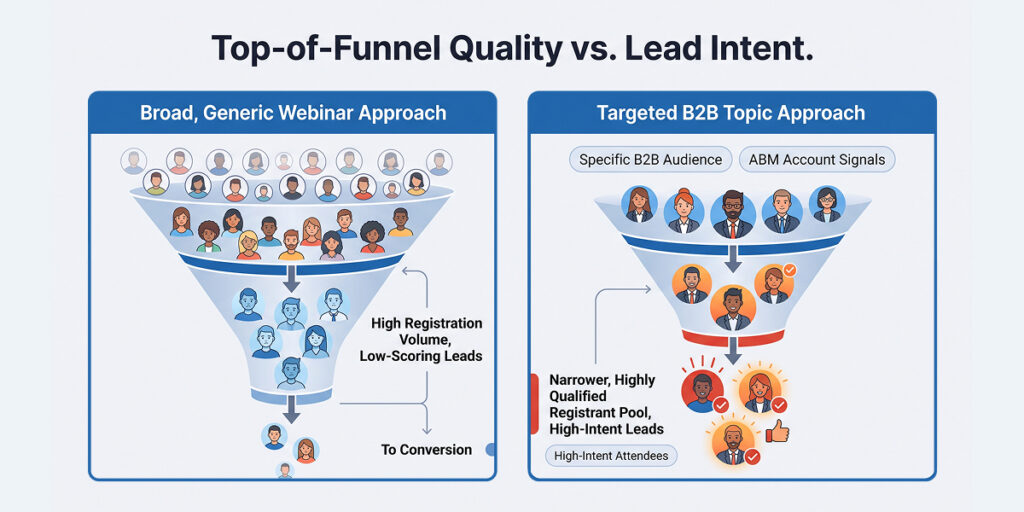
Start with your target audience and work backward. A webinar topic built for one specific buyer draws fewer registrations and far more high-quality leads than a broad one. Make your landing pages say plainly who the session is for. Your registration rates may dip slightly, and your scores will rise.
Where registrants come from matters too. Your own email list tends to show up at higher attendance rates than cold traffic, which is why email marketing still carries most webinar promotion. Paid ads, including LinkedIn ads aimed at B2B buyers, bring volume but usually lower intent, so judge them on scored leads rather than raw registrations. More on channels in our guide to promoting a webinar.
If you sell to businesses, account-based marketing (ABM) changes the math. Three people from the same company registering is a stronger buying signal than any one of them alone, so in a B2B webinar, score the account as well as the person. It’s one of the clearest places where webinars fit B2B marketing better than most channels.
Same company
Stronger buying signal
Score the account as well as the person
Not every session needs to produce pipeline this week, either. Thought leadership webinars build brand awareness and demand generation that pays off later. Score them differently, and don’t judge them on this week’s leads.
Getting more leads from one webinar
Webinar lead generation doesn’t stop when the session ends.
Content repurposing turns one session into weeks of material:
One session
- Short clips for social
- A blog post from the transcript
- The key slides as a download
- The recording itself can keep scoring leads if you run it as an automated or on-demand session, since the same behavior triggers apply.
That’s where webinar marketing becomes a content strategy rather than a string of one-off virtual events. Each session feeds the next.
Common questions
How do I follow up after a webinar?
Score first, then send. Rank each person by what they did, then give each group a different next step: a personal conversation for hot leads, a nurture sequence for warm ones, and the replay with a clear reason to watch for cold ones. Take buyers out of sales follow-up immediately.
How do I score webinar leads?
Assign points to behavior rather than registration. Attending live, staying through the offer, clicking the CTA and asking questions score highest. Sort by total into hot, warm and cold, then check your weights against who actually buys and adjust.
Is webinar lead generation worth it for B2B?
Usually, because webinars produce behavioral data most B2B lead generation channels can’t. A whitepaper download tells you someone wanted a PDF. A webinar tells you whether they stayed for the pitch, asked about pricing, or brought colleagues. That’s the data that separates a lead from a name on a list.